Most companies building air compression therapy devices have not registered one thing: at FDA your product may sit in two entirely different categories, running down two separate routes, against two completely different sets of competitors.
SUNGO Lab pulled every air compression therapy device 510(k) cleared by FDA between January 2021 and July 2026, 122 clearances in total, downloaded the official decision summaries one by one and read them in full. Here is what we found.
1. First question: which one are you filing?
In Chinese the product goes by a single name. FDA splits it into two product codes sitting in different parts of the regulations:
| Product code | FDA device name | Regulation | Cleared in the last five years | Share from mainland China |
|---|---|---|---|---|
| JOW | Compressible Limb Sleeve (medical) | 21 CFR 870.5800, cardiovascular | 47 | 23.4% |
| IRP | Powered Inflatable Tube Massager (consumer) | 21 CFR 890.5650, physical medicine | 75 | 60.0% |
JOW sits in the cardiovascular section and maps to medical uses such as DVT prophylaxis and lymphoedema management. Every one of them is prescription (Rx). IRP sits in physical medicine and maps to recovery massage; in our sample 47 of them are OTC.
The two market structures are mirror images. On the medical side US manufacturers hold 53% and mainland China only 23.4%, which makes it one of the few segments in recent years that the Chinese supply chain has not taken over. On the consumer side mainland China already holds six out of ten clearances.
Pick the wrong code and your entire test plan and predicate selection have to be rebuilt from scratch. Nailing this down is the first thing to do before you file anything.
2. The test list runs on the IEC 60601 family
Unlike wheelchairs, where ISO 7176 dominates, the backbone here is medical electrical safety. Ranked by how often each standard is cited:
| Standard | Limb sleeve (JOW) | Massager (IRP) | What it covers |
|---|---|---|---|
| IEC 60601-1-2 | 57% | 75% | Electromagnetic compatibility |
| IEC 60601-1 | 51% | 64% | Basic safety of medical electrical equipment |
| IEC 60601-1-11 | 43% | 60% | Home healthcare environment |
| ISO 10993-5 / -10 | 32% | 48% | Biocompatibility (cytotoxicity / sensitisation) |
| IEC 62304 | 23% | - | Medical device software life cycle |
| IEC 62133-2 | - | 25% | Lithium battery safety |
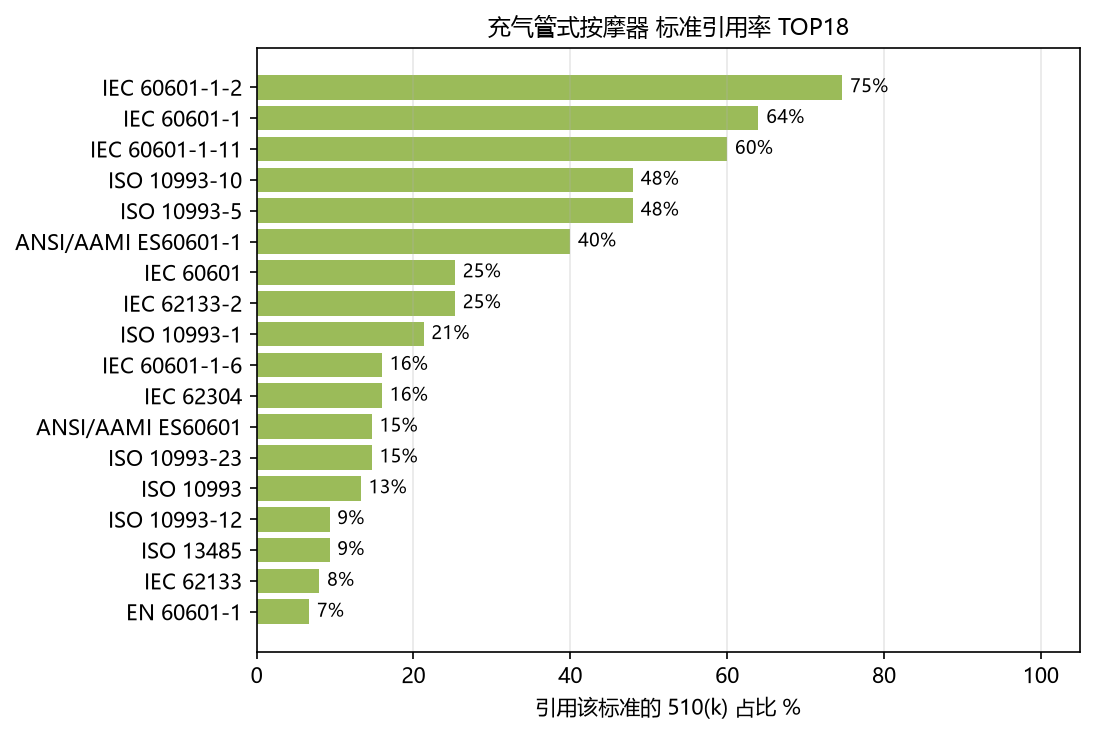
Figure 1. Top 18 standards cited for powered inflatable tube massagers (IRP)
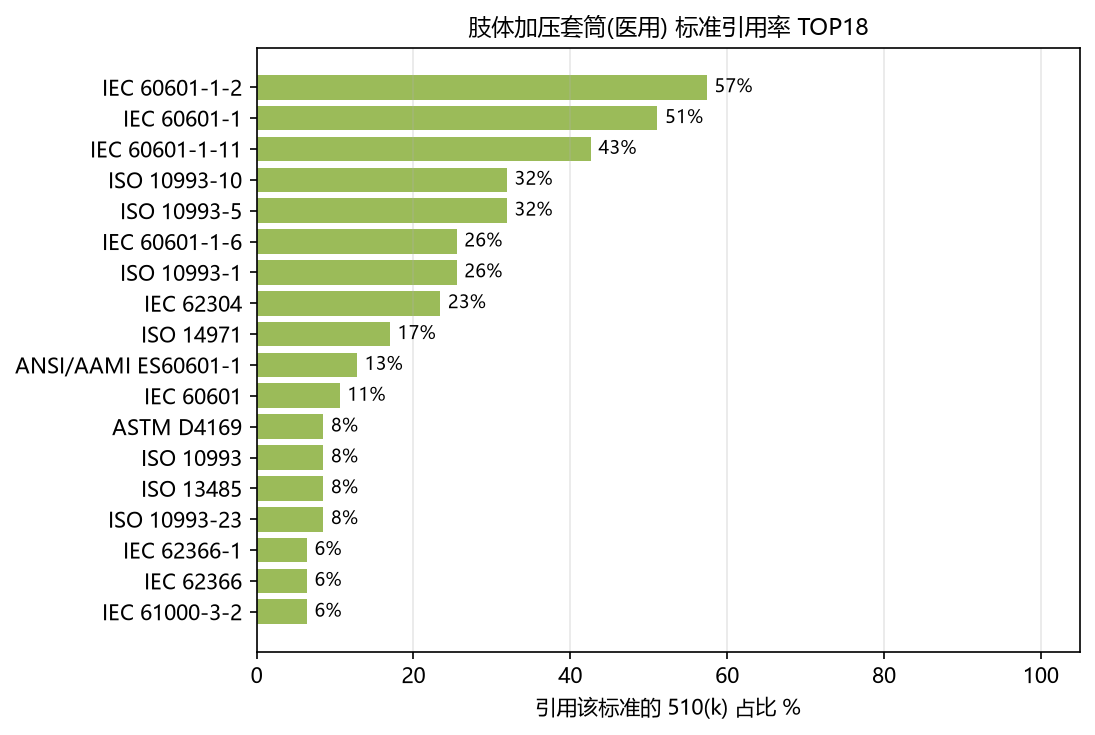
Figure 2. Top 18 standards cited for compressible limb sleeves (JOW)
The high coverage of IEC 60601-1-11 is a signal worth reading. That collateral standard covers the home healthcare environment, it appears in 43% to 60% of files, and it pairs with a home use technical characteristic that shows up in 85% to 93% of them. The centre of gravity in this category has moved out of the hospital and into the home. Designing for home use changes the requirements around thermal behaviour, drop, foreseeable misuse and ingress protection compared with an institutional setting.
The other one that gets missed is IEC 62304. On the medical side 23% of files cite it, and there is no way around it once the controller carries programmable logic. In our sample 80 products explicitly contain software, which is more than six in ten.
3. Benchmarks: Chinese manufacturers declare noticeably higher pressures
We read 121 full-text summaries and extracted the technical characteristics of every device. The split on declared pressure is worth a close look:
| Segment | Median declared pressure, mainland China vs manufacturers elsewhere |
|---|---|
| Compressible limb sleeve (JOW) | Roughly 20% higher |
| Powered inflatable tube massager (IRP) | Roughly 38% higher |
Pressure is the easiest parameter to turn into a selling point, and it also raises the bar on the safety argument at the same time. The higher the pressure, the more demanding the verification of pressure accuracy, over-pressure protection and failure modes becomes. Pushing the pressure up is easy. Explaining why that pressure is safe is not.
Other benchmarks across the full sample: three to four air chambers is typical, and cycle time and unit weight both cluster in a narrow band. The specific values are in the full reports.
- Ingress protection is a blank space. Only 13% of medical files and 3% of consumer files disclose an IP rating at all. For a product aimed at home use that is both a differentiation opportunity and a likely source of deficiency questions.
4. Review route: Special 510(k) actually works in this category
In most categories the Special 510(k) route, intended for design changes to your own cleared device with a 30-day review goal, exists mainly on paper. Air compression therapy is an exception:
| Segment | Traditional | Special | Abbreviated | Special share |
|---|---|---|---|---|
| Limb sleeve (JOW) | 35 | 11 | 1 | 23.4% |
| Massager (IRP) | 68 | 7 | - | 9.3% |
Nearly a quarter of medical-side clearances went through the Special route. The implication is straightforward: once you hold a cleared 510(k), the cost of iterating later models drops sharply. Put the other way round, the strategic value of the first clearance is much larger than the clearance itself.
Median review time was 143 days on the medical side and 139 days on the consumer side, with an interquartile range of 67 to 244 days. FDA's statutory goal is 90 review days, and the difference is consumed almost entirely by deficiency rounds.
5. Clinical data is essentially not required
Of the 122 files, 44 explicitly state that no clinical testing was required and 62 do not mention clinical data at all. Only 16 contain a clinical reference in a non-negative context, and most of those are section headings from the FDA summary template.
The conclusion is clear enough: substantial equivalence here is built on bench testing and comparison of technical characteristics. Development budget belongs in the completeness of the test reports and the rigour of the predicate comparison table, not in clinical evidence.
Full reports
The above is a summary. This study is split into two volumes by product code. Both are complete versions, downloadable directly with no registration required.
Both volumes follow the same structure, with seven chapters each: study summary, data sources and method including limitations, overall market access picture, review routes and timelines, analysis of performance testing requirements, technical characteristics and how they are evolving, and implications for a 510(k) submission.
Two notes on how the data should be read. The citation rate for a standard is counted as whether the decision summary mentions it, which reflects industry practice rather than any mandatory FDA list. Review time is measured in calendar days from acceptance to decision and includes the time the applicant spends preparing responses, which is not the same thing as FDA's statutory review clock. Both points are set out in full in the data sources and method chapter of each report.
What SUNGO can offer
SUNGO Lab provides electrical safety, electromagnetic compatibility, biocompatibility and software-related testing for medical electrical equipment. We are accredited by CNAS, CMA and IAS (USA), with laboratories in Shanghai and Hefei. To be clear about what that means: an accreditation mark only demonstrates that the laboratory has the corresponding technical competence within its accredited scope, and does not constitute a commitment as to the outcome of market access in any target market. Whether a product is cleared for marketing depends on the completeness of the submission and the competent authority's review.
For air compression therapy devices specifically, we can help confirm which product code your device belongs to, build the test item list for that category, run the electrical safety and EMC testing, and format reports to suit the requirements of a 510(k) submission. See electrical safety testing, EMC testing and biocompatibility testing, and more technical articles under knowledge.
If you need to confirm whether your product runs as JOW or IRP, work out the test list, or size the sample quantity, get in touch: call +86 132 4819 8029 or request a quote.